

Few classroom demos get attention like dry ice experiments. The rolling fog, the bubbling “potions,” the balloon that inflates by itself — students remember these lessons for years. Dry ice is solid carbon dioxide at -78.5°C, and because it sublimates (turns straight from solid into gas), it creates effects that ordinary ice simply cannot. These dry ice experiments use simple materials, so any school can run them without a full lab.
This guide lists five classic, low-cost dry ice experiments for schools and universities in Pakistan, what each one teaches, and the safety rules that must come first. If you are new to the basics, start with our explainer on what dry ice is and how to handle it safely.

Safety First: Rules That Are Not Optional
Read this section before any experiment. These dry ice experiments make brilliant lessons, but dry ice is an extreme-cold material.
- Adult supervision always. A teacher or lab instructor must run or supervise every activity.
- Gloves and tongs only. Never touch dry ice with bare hands — it causes cold burns. Use insulated gloves and tongs, and wear safety goggles.
- Ventilation is essential. Dry ice releases carbon dioxide gas. Work in a well-ventilated room or outdoors, and never in a small closed space.
- Never seal it in an airtight container. Gas builds up pressure as dry ice sublimates. Sealing it in a bottle, jar, or flask can make the container burst violently. Never attempt any “sealed bottle” experiment.
- Never eat or drink it. Dry ice must never go in mouths, drinks, or food that will be eaten directly. Fog effects on food displays are for presentation only, handled by adults.
- Store it right. Keep it in a ventilated cooler (not airtight), away from younger children, and use it the same day.
5 Classic Dry Ice Experiments
1. Fog Bubbles
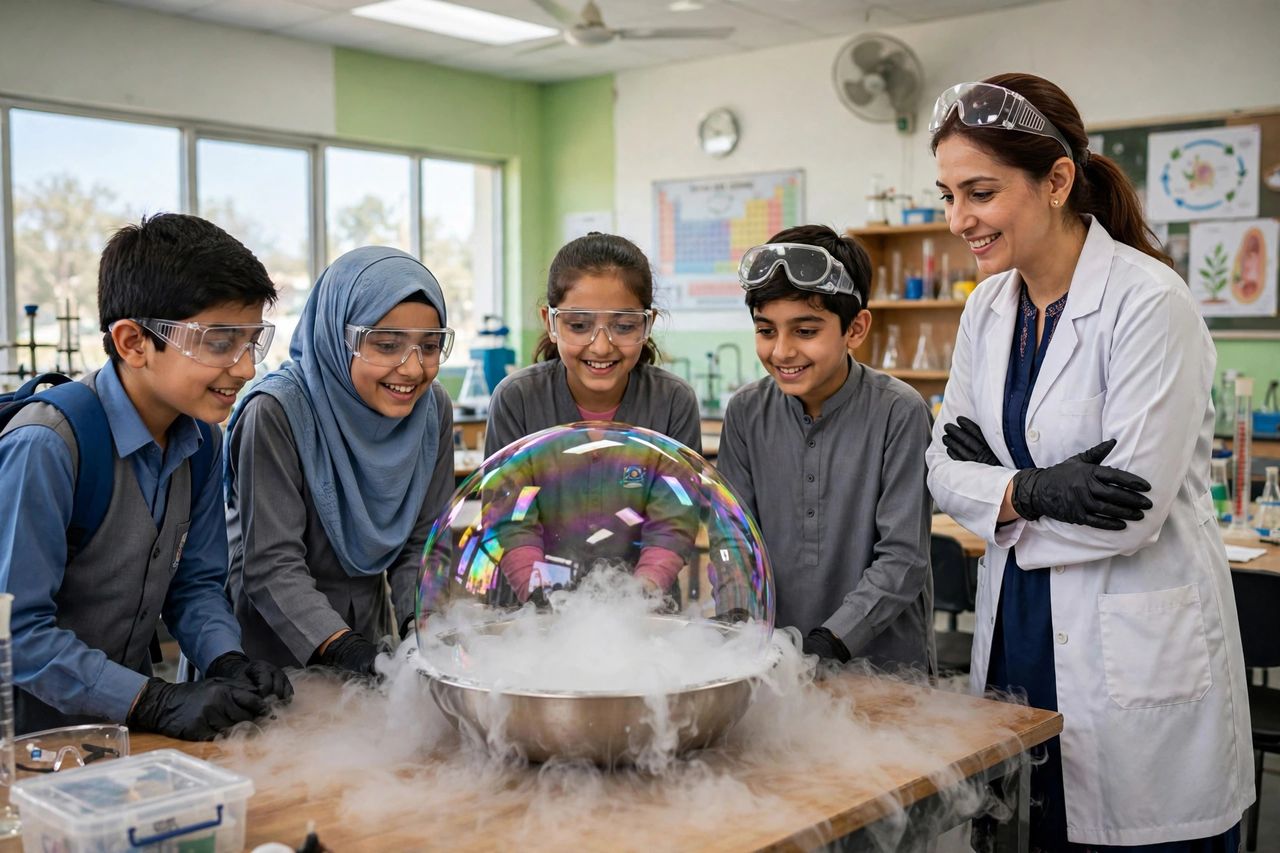
Materials: Warm water, a bowl, a small piece of dry ice, dish soap solution, a strip of cloth.
Method: Add dry ice to warm water to make fog. Dip the cloth strip in soap solution and draw it across the bowl’s rim to form a film. Watch a giant fog-filled bubble dome grow.
What it teaches: Sublimation and gas expansion — the CO2 gas inflating the bubble is the same gas that was locked in the solid.
2. CO2 Volcano
Materials: A bottle or jug (never sealed), warm water, dry ice, a funnel-shaped cover or play-dough “mountain.”
Method: Place dry ice and warm water inside the volcano model and let the fog pour out of the crater and down the slopes.
What it teaches: How gases flow and sink. CO2 is heavier than air, so the “lava” fog hugs the ground instead of rising like smoke.

3. Fog Waterfall
Materials: A tall jug of warm water, dry ice, a ramp or steps.
Method: Add dry ice to the jug at the top of the ramp and watch the fog cascade down like a white waterfall.
What it teaches: Density — students see directly that carbon dioxide is denser than air.
4. Self-Inflating Balloon
Materials: A balloon, a bottle (open, never sealed or capped), small dry ice pellets, gloves.
Method: Drop a few small pellets into the bottle, stretch the balloon over the mouth, and watch it inflate as the ice sublimates. Remove the balloon before it over-expands.
What it teaches: Change of state and gas pressure — a solid turning into a much larger volume of gas. Schools in Lahore often pick this one for science week because the whole class can see the result; small quantities are easy to arrange when you order dry ice in Lahore ahead.
5. The Singing Spoon
Materials: A metal spoon or comb, a piece of dry ice, gloves.
Method: Press the warm metal spoon against the dry ice. The spoon vibrates and “sings” as gas escapes in tiny rapid bursts.
What it teaches: Vibration and sound — rapid sublimation at the contact point creates the buzzing tone.
What You Need, at a Glance
Almost every one of these dry ice experiments uses the same simple kit:
| Item | Why |
|---|---|
| Dry ice pellets or small pieces (1–3 kg is plenty for a class) | Pellets are easy to portion for each group |
| Insulated gloves and tongs | Safe handling, always |
| Safety goggles | Protects eyes from splashes and chips |
| Bowls, jugs, balloons, dish soap | For the experiments above |
| A ventilated cooler (not airtight) | Short-term holding during the school day |
Schools usually need only a small order: pellets and small pieces are easiest to divide between student groups. Compare options on our dry ice sizes page, and see also our services for research and education.
Ordering Dry Ice for a School or University in Pakistan
Order a day or two ahead and receive delivery on the morning of the activity, because dry ice loses mass from the moment it is packed. Institutions in Karachi can arrange pickup, while schools in Lahore and Islamabad plan around delivery timing. Tell us it is for a student activity, and we will suggest a sensible quantity.
FAQs
Are dry ice experiments safe for students?
Yes, with adult supervision, gloves, goggles, and ventilation — and by never sealing dry ice in an airtight container and never letting students touch or eat it.
How much dry ice does a school need for a demo day?
For a single class session, 1–3 kg of pellets or small pieces is usually enough for several experiments. Larger science fairs may need 5 kg or more.
Can students touch dry ice with gloves on?
Only thick insulated gloves should be used, and tongs are better. Thin disposable gloves do not protect against -78.5°C cold.
What are the easiest dry ice experiments for beginners?
Fog bubbles and the self-inflating balloon are the easiest starting points — both need only a few pellets, warm water and basic items, and the results are visible to the whole class.
Where can schools in Pakistan buy small quantities of dry ice?
Pak Dry Ice supplies small and bulk quantities for dry ice experiments for schools, colleges, and universities, with Karachi pickup and delivery options in Karachi, Lahore, Islamabad, and nationwide. Schools planning dry ice experiments can order a day or two ahead, so the ice is fresh on demo day.
Plan Your School’s Demo Day
Tell us your class size and activity date, and we will portion the right amount. Message Pak Dry Ice on WhatsApp at 0304 2704492 or reach us through our contact page — we are open daily from 12 PM to 12 AM. Book your dry ice experiments order today and we will portion the right amount for your class.
Find Pak Dry Ice on Google
Pak Dry Ice is rated 4.9 stars on Google from 29 customer reviews. You can also find Pak Dry Ice on Google to see reviews, photos, timings and directions. If we have served you, a quick review helps other customers in Pakistan find a reliable dry ice supplier: Find & Review Pak Dry Ice on Google